
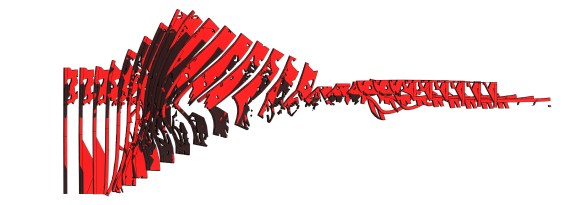
The Bartlett Coppice proposal looks to increase accidental interactions between different building users by defining temporal spaces and inhibiting movement through transitional spaces.
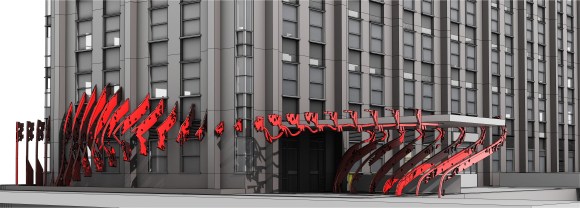
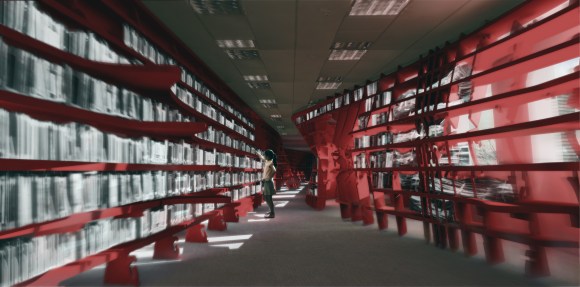
The project is based within an Architecture School and proposes to expand the thresholds between spaces, replacing doors and walls with a series of directional and semi-permeable ribs.


By aligning the ribs with fix points of projection different levels of privacy can be crated between adjacent spaces with a greater transparency when looking directly from a point of projection and an opacity when viewed from an oblique angle.


The form of the ribs is devised to interrupt the natural flow of movement through transitional spaces, forcing pinch points and creating eddies in the movement through the space. Passage through the ribs can only be perceived from fix positions forcing the inhabitants to further explore to adjacent spaces and increasing the chance that will become lost.
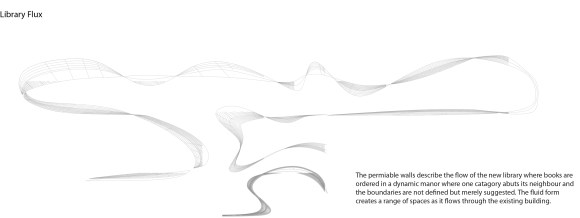
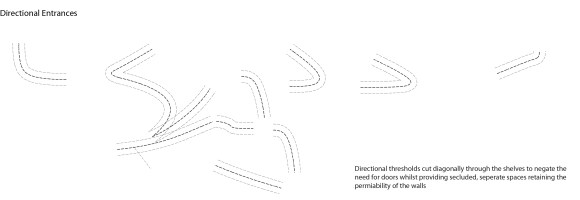
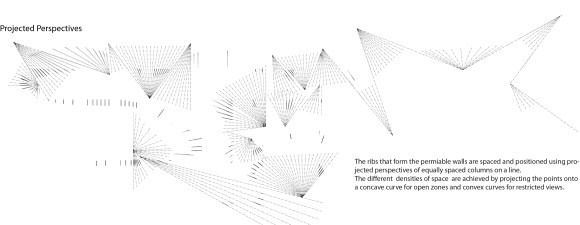
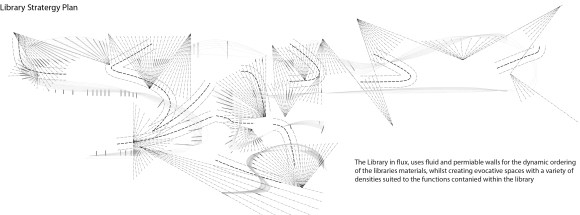
The expanded thresholds are envisaged as adaptive display elements, within which greater privacy can be achieved by displaying work within the ribs, creating greater exposure for the students that seek privacy. The exception to this rule is the library, where the collection is permanently exhibited and the study spaces are enclosed by the collections, encouraging student studying similar topics to work in closer proximity with one another.
 SAMWITHTHEPLAN